
Table of Contents
Introduction
Large format 3D printing has transformed manufacturing, prototyping, and product design across the United States. Unlike standard desktop 3D printers, large-format machines are engineered to produce full-scale parts, large prototypes, industrial tools, and even architectural structures in a single print. This capability reduces assembly time, improves structural integrity, and accelerates product development cycles.
In the U.S., industries such as aerospace, automotive, defense, healthcare, and construction rely heavily on large-format additive manufacturing (AM). With advancements in Fused Deposition Modeling (FDM), pellet extrusion, and high-temperature printing, these printers are now capable of producing durable, functional end-use parts.
Large Format 3D Printer Overview
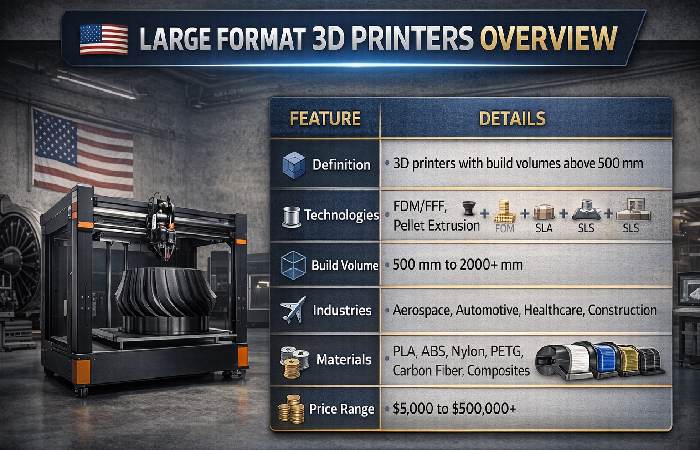
| Feature | Details |
| Definition | 3D printers with build volumes typically above 500 mm in at least one axis |
| Technologies | FDM/FFF, Pellet extrusion, SLA, SLS |
| Build Volume | 500 mm to 2000+ mm |
| Industries | Aerospace, Automotive, Healthcare, Construction |
| Materials | PLA, ABS, Nylon, PETG, Carbon Fiber, Composites |
| Price Range | $5,000 to $500,000+ |
Large-format printers enable the production of large, complex geometries without splitting models into smaller parts.
What is a Large Format 3D Printer?
A large format 3D printer is an industrial-grade machine designed to fabricate oversized objects or high volumes of smaller parts simultaneously. These printers are significantly larger than desktop models and are often used in professional and industrial environments.
For example, the BigRep ONE offers a build volume of approximately 1 cubic meter, allowing users to print full-scale prototypes or tooling in one piece.
Unlike traditional manufacturing, which involves cutting or molding materials, large-format 3D printing uses additive manufacturing, where objects are built layer by layer from digital models.
Key Features of Large Format 3D Printers
| Feature | Description |
| Large Build Volume | Enables printing of large parts in a single job |
| Industrial Construction | Heavy-duty steel frames for stability |
| Multi-Material Printing | Supports dual or multiple extruders |
| High Throughput | Faster production for industrial use |
| Automation | Auto-calibration, filament handling |
| Material Flexibility | Compatible with engineering-grade materials |
Many industrial machines include automated systems and high-performance materials to ensure consistent results in production environments.
Major Large Format 3D Printer Manufacturers in the United States
1. BigRep (Industrial Leader)
| Model | Build Volume | Use Case |
| BigRep ONE | ~1000 x 1000 x 1000 mm | Prototyping |
| BigRep PRO | Large industrial scale | Manufacturing |
| BigRep VIIO 250 | Automated production | Continuous use |
BigRep printers are widely used in automotive and aerospace industries for producing full-scale prototypes and tooling.
2. Stratasys (Enterprise Solutions)
The Stratasys F770 is one of the most popular large-format industrial printers.
| Feature | Specification |
| Build Volume | 13 cubic feet |
| Technology | FDM |
| Applications | Aerospace, automotive, medical |
This printer allows users to produce large parts without splitting them, improving efficiency and accuracy.
3. IC3D (Virago Series)
| Feature | Specification |
| Model | Virago 1200 |
| Build Volume | 1230 x 1250 x 1205 mm |
| Special Feature | Multi-tool head system |
The Virago 1200 supports filament and pellet extrusion, making it suitable for large-scale industrial production.
4. SynDaver (Professional Large Printers)
| Feature | Details |
| Build Volume | Up to 1 m³ |
| Technology | Dual extrusion |
| Applications | Medical, education, manufacturing |
These printers are known for ease of use and versatility in producing large functional parts.
5. Custom Manufacturers (USA-Based)
Companies like Stabilus 3D offer custom-built large-format printers with sizes ranging from 500 mm to 2000+ mm depending on requirements.
Applications of Large Format 3D Printing
| Industry | Use Case |
| Aerospace | Lightweight components |
| Automotive | Prototypes and tooling |
| Defense | Custom equipment |
| Manufacturing | Jigs and fixtures |
Large-format printers are widely used to create functional prototypes and end-use parts, reducing production costs and time.
Commercial Applications
| Sector | Use Case |
| Architecture | Scale models |
| Construction | Building components |
| Retail | Displays and signage |
| Entertainment | Props and sets |
Medical Applications
| Use Case | Description |
| Prosthetics | Custom-fit devices |
| Anatomical Models | Surgical planning |
| Bioprinting | Tissue research |
Advantages of Large Format 3D Printers
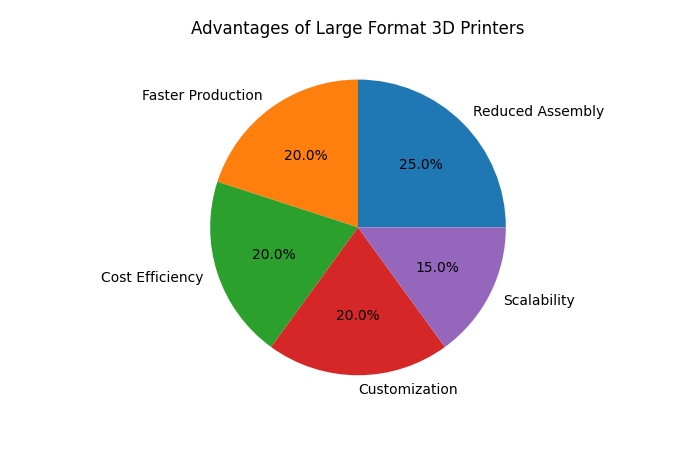
| Advantage | Explanation |
| Reduced Assembly | Print large parts in one piece |
| Faster Production | High throughput systems |
| Cost Efficiency | Lower material waste |
| Customization | Fully customizable designs |
| Scalability | Ideal for mass production |
Large-format printers allow companies to produce large objects without joining multiple parts, saving time and improving durability.
Challenges and Limitations
| Challenge | Explanation |
| High Cost | Expensive initial investment |
| Material Handling | Complex for large prints |
| Warping Issues | Especially with large parts |
| Space Requirement | Requires industrial space |
| Maintenance | Needs skilled operators |
From community discussions, users often highlight material handling and reliability as key challenges in large-scale printing.
Pricing of Large Format 3D Printers in the U.S.
| Category | Price Range |
| Entry-Level Large Format | $5,000 – $20,000 |
| Mid-Range Industrial | $20,000 – $100,000 |
| High-End Industrial | $100,000 – $500,000+ |
Prices vary depending on build size, automation, and material compatibility.
Buying Guide: How to Choose the Right Printer
| Factor | What to Consider |
| Build Volume | Size of parts you need |
| Material Compatibility | Engineering materials support |
| Speed | Production requirements |
| Precision | Required accuracy |
| Budget | Total cost including maintenance |
Expert Tips
- Choose enclosed printers for high-temperature materials like ABS or Nylon
- Consider printers with automatic calibration for ease of use
- Evaluate software compatibility and support
Future Trends in Large Format 3D Printing
1. Automation and AI Integration
Modern systems are integrating AI-based monitoring to detect and fix print errors automatically.
2. Hybrid Manufacturing
Combining additive and subtractive processes for better precision.
3. Sustainable Materials
Use of recyclable and bio-based materials is increasing.
4. Construction 3D Printing
Large-scale printers are being used to build houses and infrastructure.
Comparison of Popular Large Format 3D Printers
| Printer | Build Volume | Technology | Best For |
| BigRep ONE | ~1 m³ | FDM | Prototyping |
| Stratasys F770 | 13 ft³ | FDM | Industrial use |
| Virago 1200 | 1.2 m³ | Pellet + filament | Multi-material |
| SynDaver Apogee | 1 m³ | FDM | Medical & education |
Conclusion
Large format 3D printers are revolutionizing manufacturing in the United States by enabling full-scale production, rapid prototyping, and cost-effective customization. With advancements in materials, automation, and software, these machines are becoming essential tools for modern industries.
Whether you are a manufacturer, engineer, or entrepreneur, investing in a large-format 3D printer can significantly improve productivity and innovation. However, choosing the right machine requires careful consideration of size, cost, materials, and application needs.
