
Table of Contents
Introduction
In the world of digital marketing, businesses want their websites to appear at the top of search engine results. Two important strategies used to achieve this are SEO (Search Engine Optimization) and SEM (Search Engine Marketing). Both methods help increase website visibility, attract visitors, and grow online businesses.
However, many beginners often get confused between SEO and SEM. Although they are related and share the same goal—getting traffic from search engines—they work in different ways. SEO focuses on organic (free) search results, while SEM includes paid advertising to appear in search engine results.
Search engines like Google, Bing, and Yahoo use complex algorithms to rank websites. Businesses optimize their websites or run ads to appear higher in these search results so that users can easily find them.
SEO vs SEM – Main Features
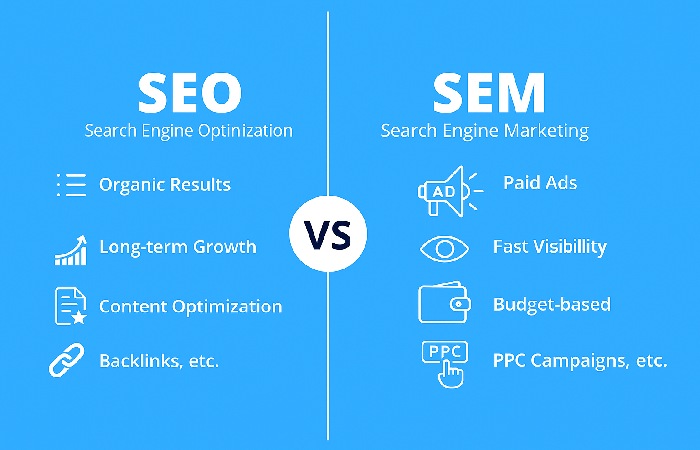
| Feature | SEO (Search Engine Optimization) | SEM (Search Engine Marketing) |
| Definition | Process of optimizing a website to improve organic search rankings | Marketing strategy that uses paid advertisements in search engines |
| Traffic Type | Organic (free) traffic from search engines | Paid traffic through ads |
| Cost | No direct cost for clicks, but requires time and effort | Pay-per-click (PPC) or paid advertising budget required |
| Speed of Results | Slow, usually takes months to rank | Very fast, results appear immediately after ads run |
| Longevity | Long-term results even after optimization | Stops when advertising budget stops |
| Click Cost | Free clicks | Advertisers pay for every click |
| Strategy | Content optimization, backlinks, technical improvements | Keyword bidding, ad campaigns, paid placements |
| Visibility | Appears in organic search results | Appears in sponsored or ad sections of search results |
| Trust Level | Higher user trust because results are organic | Slightly lower trust as results are marked as ads |
| Maintenance | Requires regular content updates and SEO improvements | Requires continuous ad management and budget |
How Does SEO Work?
SEO works by optimizing a website so that search engines can easily understand its content and rank it higher in search results.
Search engines use crawlers (bots) to scan websites. These bots analyze content, keywords, links, and website structure to determine which pages are most relevant for a search query.
Here are the main steps of how SEO works:
1. Keyword Research
Keyword research is the process of finding the words and phrases people search for online. These keywords help search engines understand what your content is about.
Example keywords:
- Best smartphones
- SEO tips
- Digital marketing course
Using the right keywords improves your chances of ranking higher.
2. On-Page SEO
On-page SEO involves optimizing elements inside your website.
Important on-page SEO elements include:
- Title tags
- Meta descriptions
- Headings (H1, H2, H3)
- Keyword placement
- Internal linking
- Image optimization
Good on-page SEO helps search engines understand the page content better.
3. Technical SEO
Technical SEO focuses on the technical aspects of a website.
Examples include:
- Website speed
- Mobile friendliness
- Secure HTTPS connection
- XML sitemap
- Clean URL structure
A technically optimized website improves search engine crawling and indexing.
4. Off-Page SEO
Off-page SEO mainly refers to backlinks. Backlinks are links from other websites pointing to your website.
Search engines see backlinks as a sign of trust and authority.
Common off-page SEO strategies include:
- Guest blogging
- Social media promotion
- Influencer outreach
- Directory submissions
5. Content Quality
High-quality content plays a major role in SEO. Search engines prioritize content that is:
- Informative
- Original
- Relevant
- Useful to readers
Regularly publishing quality content helps websites gain better rankings.
SEO vs SEM – Main Features
Both SEO and SEM are essential parts of digital marketing, but they differ in strategy, cost, and results.
| Feature | SEO | SEM |
| Traffic Source | Organic search | Paid advertisements |
| Time to Rank | Long-term strategy | Instant visibility |
| Budget Requirement | Low budget | Requires advertising budget |
| Sustainability | Long-lasting results | Results stop when ads stop |
| Click Cost | Free clicks | Pay-per-click (PPC) |
| Trust Level | Higher user trust | Slightly lower trust |
| Targeting | Keyword optimization | Keyword bidding and audience targeting |
Many companies use both SEO and SEM together for better results.
SEO vs SEM: Which Is Better?
Choosing between SEO and SEM depends on business goals, budget, and time frame.
| Criteria | SEO | SEM |
| Best For | Long-term growth | Quick traffic |
| Budget | Small to medium | Medium to high |
| Result Speed | Slow | Very fast |
| Sustainability | High | Low if ads stop |
| ROI (Long-Term) | Higher | Moderate |
| Ideal Users | Bloggers, startups, content websites | Businesses, e-commerce, product launches |
When to choose SEO:
- You want long-term traffic
- You have limited marketing budget
- You focus on content marketing
When to choose SEM:
- You want quick sales
- You are launching a new product
- You need immediate website traffic
In many cases, the best strategy is to combine SEO and SEM.
How Much Do SEO and SEM Cost?
The cost of SEO and SEM varies depending on business size, industry competition, and marketing goals.
| Marketing Method | Average Cost | Cost Structure |
| SEO (DIY) | Free | Time and effort |
| SEO Freelancer | $200 – $2000 per month | Monthly service |
| SEO Agency | $1000 – $10,000+ per month | Professional service |
| SEM (Google Ads) | $0.50 – $5 per click | Pay-per-click |
| SEM Monthly Budget | $500 – $10,000+ | Advertising campaigns |
| Enterprise SEM | $10,000 – $100,000+ | Large marketing budgets |
SEO and SEM in Digital Marketing
SEO and SEM are key components of digital marketing strategies.
Digital marketing includes various online promotion methods such as:
- Search engine marketing
- Social media marketing
- Email marketing
- Content marketing
- Affiliate marketing
SEO helps build organic traffic, which is highly valuable because users trust natural search results.
SEM helps businesses reach target audiences instantly through paid ads.
For example:
- An online store may use SEO to rank product pages.
- The same store may run SEM ads during special promotions.
Benefits of using SEO and SEM together:
- Increased website visibility
- More website traffic
- Higher conversion rates
- Better brand awareness
- Faster business growth
Companies that combine both strategies often achieve the best digital marketing results.
Conclusion
SEO and SEM are two powerful strategies used to increase website visibility in search engines. While both aim to attract visitors, they work in different ways.
SEO focuses on organic search results, improving website content, structure, and authority over time. It is a long-term strategy that provides sustainable traffic without paying for each click.
SEM, on the other hand, uses paid advertising to place websites at the top of search engine results instantly. It delivers fast results but requires continuous investment.
FAQs
1. What is SEO?
SEO (Search Engine Optimization) is the process of improving a website so that it ranks higher in organic search results on search engines like Google.
2. What is SEM?
SEM (Search Engine Marketing) is a digital marketing strategy that uses paid advertisements to increase visibility on search engines.
3. Is SEO better than SEM?
SEO is better for long-term growth, while SEM is better for quick results. Both strategies are useful depending on business goals.
4. Can SEO and SEM work together?
Yes. Many businesses use both strategies together to maximize website traffic and conversions.
5. How long does SEO take to show results?
SEO usually takes 3 to 6 months to show noticeable results, depending on competition and website optimization.
