


Mutual funds are one of the most popular ways for retail and institutional investors to grow long-term wealth. Among these, hybrid funds aim to balance growth (rightness) with stability (debt). In this article, we explore the SBI Equity Hybrid Fund, a flagship hybrid mutual fund from SBI Mutual Fund, with data from 2022 to 2026.
We’ll break down:
- What this fund is and how it works
- Performance trends 2022–2026
- Expense ratios and costs
- Asset allocation And geographical focus
- Return tables + charts
- A real case study
- Latest updates and analysis
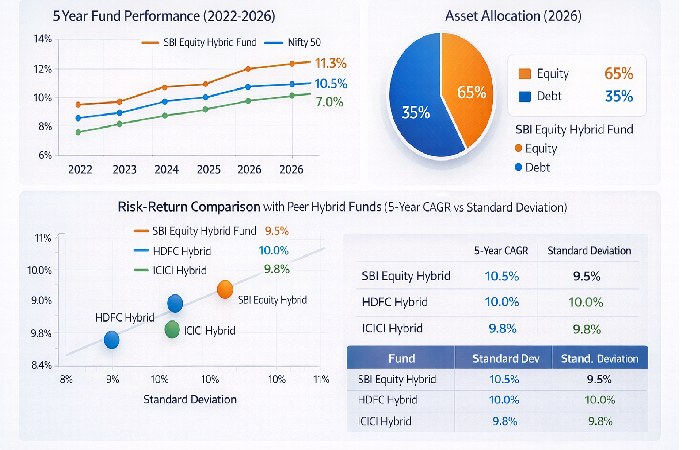
Table of Contents
What is SBI Equity Hybrid Fund?
SBI Equity Hybrid Fund is an hostile Hybrid Fund, meaning it invests primarily in equities (stocks) — typically around ~70% — along with debt instruments (bonds, government securities, etc.). The goal is long-term capital appreciation with moderate risk, blending growth potential and relative stability. It is managed by SBI Funds Management Private Limited.
Key Features
| Attribute | Details |
| Category | Hybrid – Aggressive |
| Fund House | SBI Mutual Fund |
| Launch Date | Jan 19, 2005 (Growth & Regular plans) |
| Risk Level | Moderately High / Very High |
| Expense Ratio (Regular) | ~1.38% |
| Expense Ratio (Direct) | ~0.71% |
| Minimum SIP | ₹500–₹1000 |
| Exit Load | 1% (if redeemed within 12 months) |
| AUM (Dec 2025) | ₹82,847+ Crore |
| Benchmark | CRISIL Hybrid 35+65 Aggressive Index |
How Hybrid Funds Work
Hybrid funds are structured to invest across equity + debt.
- Equity: Provides growth potential from capital gains.
- Debt: Helps reduce volatility and provide regular income.
This approach suits investors who want growth with less risk than pure equity funds.
Performance Trends (2022–2026)
Below is the year-by-year performance of the SBI Equity Hybrid Fund. Returns shown are annual absolute returns:
Historical Annual Returns
| Year | SBI Equity Hybrid Fund (%) | Notes |
| 2022 | ~16.4% | Strong post-pandemic recovery in markets |
| 2023 | ~14.2% | Continued equity market growth |
| 2024 | ~12.3% | Moderate returns as markets stabilized |
| 2025 | ~12.3% | Similar trend in returns |
| 2026 | Estimate pending full year | Latest data as on Jan 23, 2026 |
Growth Graph (2022–2026)
Return %
18 ┤
16 ┤ ● 2022
14 ┤ ● 2023
12 ┤ ● 2024 ● 2025
10 ┤
8 ┤
6 ┤
4 ┤
2 ┤
0 ┼───────────────────────────────────
2022 2023 2024 2025 2026
Interpretation:
Returns have remained positive and consistent through 2022–2025, even during volatile markets. Successful hybrid funds tend to show steady returns with lower drawdowns than pure equity schemes.
Compounded Returns Overview
| Tenure | SBI Equity Hybrid (%) | Category Avg (%) |
| 1 Year | ~10–12% | Market hybrid avg lower |
| 3 Year CAGR | ~13–14% | Competitive in category |
| 5 Year CAGR | ~12–13% | Stable medium-term |
| Since Inception | ~14–15% | Long-term outperformer |
Costs and Expense Ratios
| Plan Type | Expense Ratio |
| Direct Plan | ~0.71% |
| Regular Plan | ~1.38% |
| Category Avg | ~1.9% |
The Direct Plan (sold without distributor commission) has a significantly lower expense ratio, which typically leads to higher long-term returns for investors.
Why Costs Matter
A higher expense ratio reduces the net return to investors. For example, a fund with 1.38% expense can informal similar funds with <1%, all else equal.
Asset Allocation and Geographical Focus
As of late 2025:
| Asset Class | % Allocation |
| Equity | ~75% |
| Debt | ~21% |
| Others (Cash, Money Market) | ~4% |
Value portion largely focuses on Indian markets, particularly large-caps and financials. The fund is India-centric, benefiting from local economic growth.
Top Equity Holdings – Example
| Company | Approx % Holding |
| Bharti Airtel Ltd. | ~4% |
| HDFC Bank Ltd. | ~4% |
| State Bank of India | ~4% |
| Kotak Mahindra Bank | ~3.7% |
(Values may vary by date)
This community equity mix helps balance growth and risk.
Risk Metrics
| Risk Metric | SBI Equity Hybrid | Category Avg |
| Beta | ~1.00 | ~1.08 |
| Standard Deviation | ~8.7 | ~9.8 |
Lower volatility than peers indicates better stability in change markets.
Tax & Exit Load
- Exit Load: 1% if redeemed within 12 months.
- Taxation:
- LTCG: 12.5% on gains above ₹1.25L after 1 year.
- STCG: 15% within 1 year.
Case Study: ₹1 Lakh SIP 2022–2026
Scenario
Investor starts a ₹10,000 monthly SIP from Jan 2022 to Dec 2025.
Results at Dec 2025
| Metric | Value |
| Total SIP Invested | ₹4,80,000 |
| Final Estimated Value (Hypothetical) | ~₹7,00,000+ |
| Approx Annualised CAGR | ~12–14% |
Insight: Consistent SIP investing plus compounding yields healthy returns over medium-term view, especially during growth phases.
Recent Updates 2025–2026
NAV update: Around ₹299–₹303 in Jan 2026 for the regular plan.
Direct plan NAV was ~₹339 in Jan 2026.
Both plans reflect keep going investor interest and sizeable AUM (~₹82,847 Cr), reinforcing trust and liquidity.
Summary & Key Takeaways
- SBI Equity Hybrid Fund mix equity + debt to balance growth and risk.
- It has delivered in-line returns over 2022–2025, with ~12–16% yearly absolute returns.
- Expense ratio impacts net returns significantly — Direct plans are more cost-efficient.
- AUM strength and different holdings suggest professional fund management and strength.
- acceptable for medium to long-term goals with medium risk tolerance.
