
Introduction
In today’s fast-changing business environment, technology, AI, automation, and hybrid work models are reshaping leadership. Managers who rely only on past experience risk becoming outdated. That’s where upskilling becomes critical.
Upskilling managers is not just about training — it’s about preparing leaders to handle digital transformation, people management challenges, data-driven decision-making, and strategic growth.
This guide explains everything you need to know — from meaning to benefits, courses, salary impact, and practical steps.
Table of Contents
What is Upskilling?
Upskilling means learning new skills or improving existing ones to stay relevant in your current role.
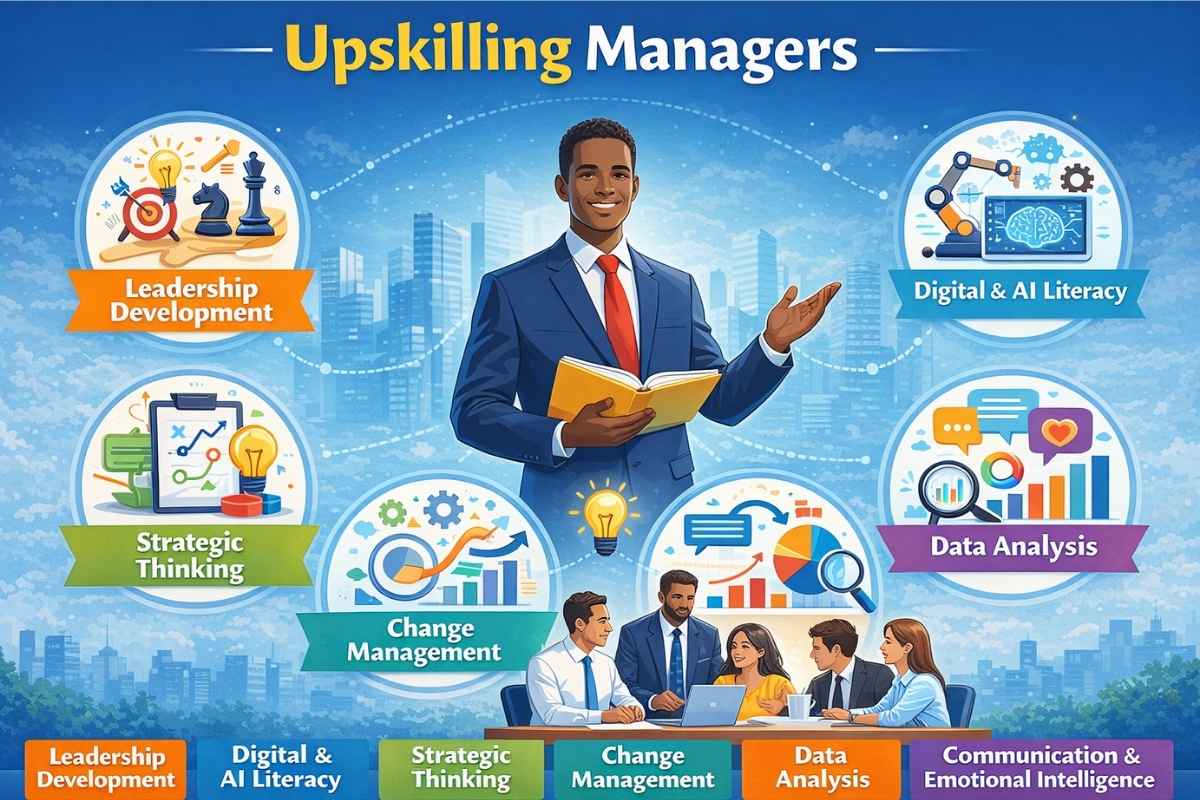
For managers, upskilling includes:
- Leadership development
- Digital & AI literacy
- Strategic thinking
- Data analysis
- Change management
- Communication & emotional intelligence
Unlike reskilling (learning for a new job), upskilling improves performance in the same career path.
Upskilling Managers Come Under Which Category?
Upskilling managers generally falls under:
| Category | Description |
| Leadership Development | Improving people management & strategic abilities |
| Corporate Training | Company-sponsored professional growth programs |
| Learning & Development (L&D) | HR-driven employee growth initiatives |
| Executive Education | Advanced management programs from universities |
| Digital Transformation Training | Training for AI, automation & tech-driven leadership |
How Upskilling Managers Can Help Your Career
Upskilling is one of the smartest career investments a manager can make in 2026. Whether you’re a team lead, project manager, or senior executive, continuously improving your skills directly impacts your career growth, earning potential, and long-term stability.
Here’s how it can help your career:
1. Increases Promotion Opportunities
When you develop advanced leadership, strategic thinking, and digital skills, you become a strong candidate for higher roles. Companies promote managers who show growth mindset and adaptability.
2. Improves Salary Potential
Managers with certifications from institutions like Harvard Business School or IIM Ahmedabad often command higher salaries because they bring advanced strategic expertise to the organization.
3. Builds Leadership Credibility
Upskilled managers demonstrate confidence, better communication, and stronger decision-making abilities. This builds trust with teams and senior leadership.
4. Enhances Job Security
In a rapidly changing economy driven by AI and automation, managers who understand digital tools and data analytics are less likely to be replaced.
5. Expands Professional Network
Executive programs and leadership workshops connect you with global professionals, mentors, and industry experts, creating future career opportunities.
6. Strengthens Decision-Making Skills
Learning finance, analytics, and strategic management improves your ability to make data-driven decisions rather than relying only on intuition.
7. Increases Adaptability
Markets evolve quickly. Upskilled managers adapt faster to organizational restructuring, new technologies, and global competition.
8. Opens International Opportunities
Global certifications and digital skills make managers competitive for overseas roles and multinational companies.
9. Boosts Confidence & Performance
When you gain new competencies, you perform better, lead stronger teams, and handle challenges more effectively.
10. Future-Proofs Your Career
Continuous learning ensures you remain relevant for the next 5–10 years, especially as AI and digital transformation reshape management roles.
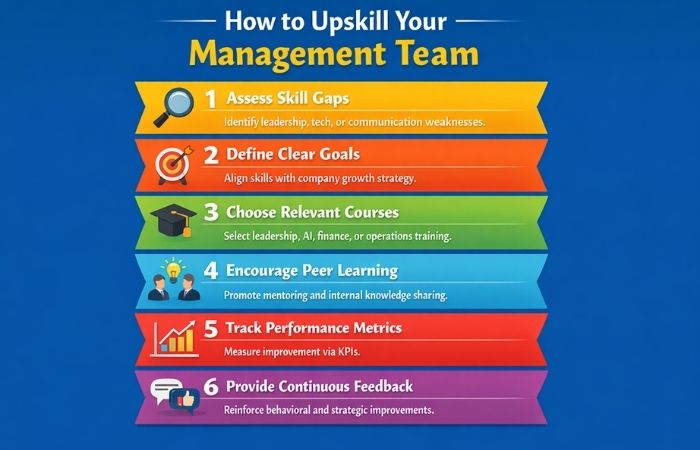
How Do I Upskill My Management Team?
Here’s a structured approach:
| Step | Action | Why It Matters |
| 1 | Assess Skill Gaps | Identify leadership, tech, or communication weaknesses |
| 2 | Define Clear Goals | Align skills with company growth strategy |
| 3 | Choose Relevant Courses | Select leadership, AI, finance, or operations training |
| 4 | Encourage Peer Learning | Promote mentoring and internal knowledge sharing |
| 5 | Track Performance Metrics | Measure improvement via KPIs |
| 6 | Provide Continuous Feedback | Reinforce behavioral and strategic improvements |
Benefits of Upskilling Managers
| Benefit | Business Impact |
| Higher Productivity | Teams perform better under skilled leadership |
| Better Employee Retention | Skilled managers reduce turnover |
| Innovation Growth | Managers drive strategic transformation |
| Improved Profitability | Better decisions improve financial performance |
| Competitive Advantage | Future-ready leadership ensures sustainability |
| Crisis Management | Upskilled leaders handle uncertainty effectively |
Upskilling Managers Tips
| Tip | Explanation |
| Focus on Soft + Tech Skills | Combine leadership & digital literacy |
| Invest in Microlearning | Short courses improve retention |
| Use Real Case Studies | Practical learning improves application |
| Encourage AI Adoption | Learn tools like ChatGPT & analytics software |
| Promote Cross-Department Exposure | Broadens strategic thinking |
| Measure ROI of Training | Track performance before & after training |
Popular Upskilling Courses for Managers (2026)
| Platform | Course Type | Best For | Approx Cost |
| Harvard Business School | Executive Leadership Programs | Senior Managers | $5,000 – $15,000 |
| INSEAD | Global Management | International Leaders | $8,000 – $20,000 |
| Coursera | Digital Strategy & AI | Mid-level Managers | $49 – $399 |
| LinkedIn Learning | Leadership & Communication | Entry-Level Managers | $20 – $40/month |
| IIM Ahmedabad | Executive Management | Indian Managers | ₹1,50,000 – ₹3,00,000 |
| ISB | Senior Leadership | C-Suite Professionals | ₹5,00,000+ |
Upskilling Managers Salaries (2026 Estimates)
Salary growth depends on skills, geography, and industry.
| Role | Before Upskilling | After Advanced Certification |
| Mid-Level Manager | ₹8–12 LPA | ₹12–18 LPA |
| Senior Manager | ₹15–25 LPA | ₹25–40 LPA |
| Operations Head | ₹20–35 LPA | ₹40–60 LPA |
| Role | Before Upskilling | After Executive Education |
| Project Manager | $75k–$95k | $100k–$130k |
| Operations Manager | $85k–$110k | $120k–$160k |
| Director-Level | $120k–$150k | $160k–$220k |
Conclusion
Upskilling managers is no longer optional — it is a strategic necessity in 2026. Organizations that invest in leadership development, digital skills, and strategic thinking outperform competitors.
For individuals, upskilling means higher salaries, better promotions, and stronger job security. For companies, it means innovation, growth, and resilience.
FAQs
1. What is the difference between upskilling and reskilling?
Upskilling improves existing skills for current roles, while reskilling prepares employees for entirely new roles.
2. How long does it take to upskill a manager?
Short courses: 4–8 weeks
Executive programs: 3–12 months
3. Is upskilling expensive?
It ranges from affordable online courses ($50) to premium executive programs ($20,000+).
4. Does upskilling guarantee promotion?
Not guaranteed, but it significantly improves promotion chances.
5. What are the most important skills managers should learn in 2026?
AI literacy, data-driven decision making, emotional intelligence, digital transformation strategy, and financial analysis.
